
Hazelwood Resident Lookup Record Roles
There is no official master list of Hazelwood residents. A careful resident lookup uses a record for the role it actually documents: registration status, a case-party role, an assessment owner, a recorded instrument, a dated directory entry, or an eligible vital event. St. Louis County is the right jurisdiction for county records, not the independent City of St. Louis. A current-looking name on one screen is only a lead until its date, source, and role agree with another record.
| Record | What it can confirm | Where | Access |
|---|---|---|---|
| Voter lookup | Registration-status and precinct result when exact fields match | Missouri Secretary of State | Free, with protected-address limits |
| Case docket | Public party, case, hearing, and disposition context | Missouri Case.net | Public search, restricted matters excluded |
| Parcel and GIS | Assessment owner, situs address, parcel, and districts | County property inquiry | Free, owner is not occupant |
| County directory | Dated historical name and address snapshot | SLCL County Directories | Search, browse, or library access |
| Vital record | Eligible certified event record | Missouri DHSS | Relationship, identification, and fee rules |
Start with the source that matches the question. A historical family-history question may begin in a directory or the Hazelwood history index, while a case question begins in Case.net. An address question begins with the County tax inquiry and GIS, then moves to a Recorder instrument. Labeling the result as an owner, party, or dated directory entry avoids turning a limited record into an unsupported claim about a present resident.
Match Hazelwood Names to Dates
Common names create the most errors in a Hazelwood resident lookup. Normalize reasonable spelling variants, preserve middle initials, and keep the county selection visible. Missouri Case.net is court-centered, not a general people index. The Secretary of State voter form needs an exact first name, a last name, house number, street name without its street type, birth date, and county. A missed match can result from an exact-name mismatch, a street-type entry, a protected address, or an address outside St. Louis County.
For older work, the St. Louis County Library Hazelwood index points to the 1992 local history book by name, page, photograph, and topic. It is a discovery lead, not proof of a current address. The library generally limits lookup requests to three targeted searches, so provide the printed name, source title, and a page or date if known.
Note: Preserve the source year and the person’s role beside every match, especially when a name appears in both a directory and a more recent county record.
Check a Hazelwood Resident Lookup in Case.net
Missouri Case.net offers litigant-name, filing-date, case-number, and scheduled-hearings-and-trials search modes. Select the appropriate court or St. Louis County, try the name and a reasonable variant, then record the court, case number, filing date, case type, party role, and docket events. The portal also offers Track This Case for eligible matters, although not every case can be tracked.
| Case.net control | How to use it |
|---|---|
| Court or county | Choose the jurisdiction before narrowing the query. |
| Litigant name | Use name mode and compare party roles for similar names. |
| Filing date | Limit the time window for the selected court. |
| Case number | Use the complete number when it is known. |
| Hearings and tracking | Review scheduled proceedings and use tracking only for eligible cases. |
A docket reflects procedure. A filing, charge, dismissal, pending entry, and final disposition are different things. Juvenile, sealed, expunged, adoption, confidential mental-health, and other protected matters may be omitted or show only a limited docket shell. If a paper record matters, confirm it with the appropriate Clerk instead of treating a search page as the complete file.
Hazelwood Municipal Courts provides a separate city route. Matters before January 12, 2020 use iPayCourt or MuniCourt, while matters from January 13, 2020 forward use Case.net. The court does not provide another party’s contact information or legal advice.
Visit the Hazelwood Municipal Courts information page for the city’s official access details before relying on a case-system path.
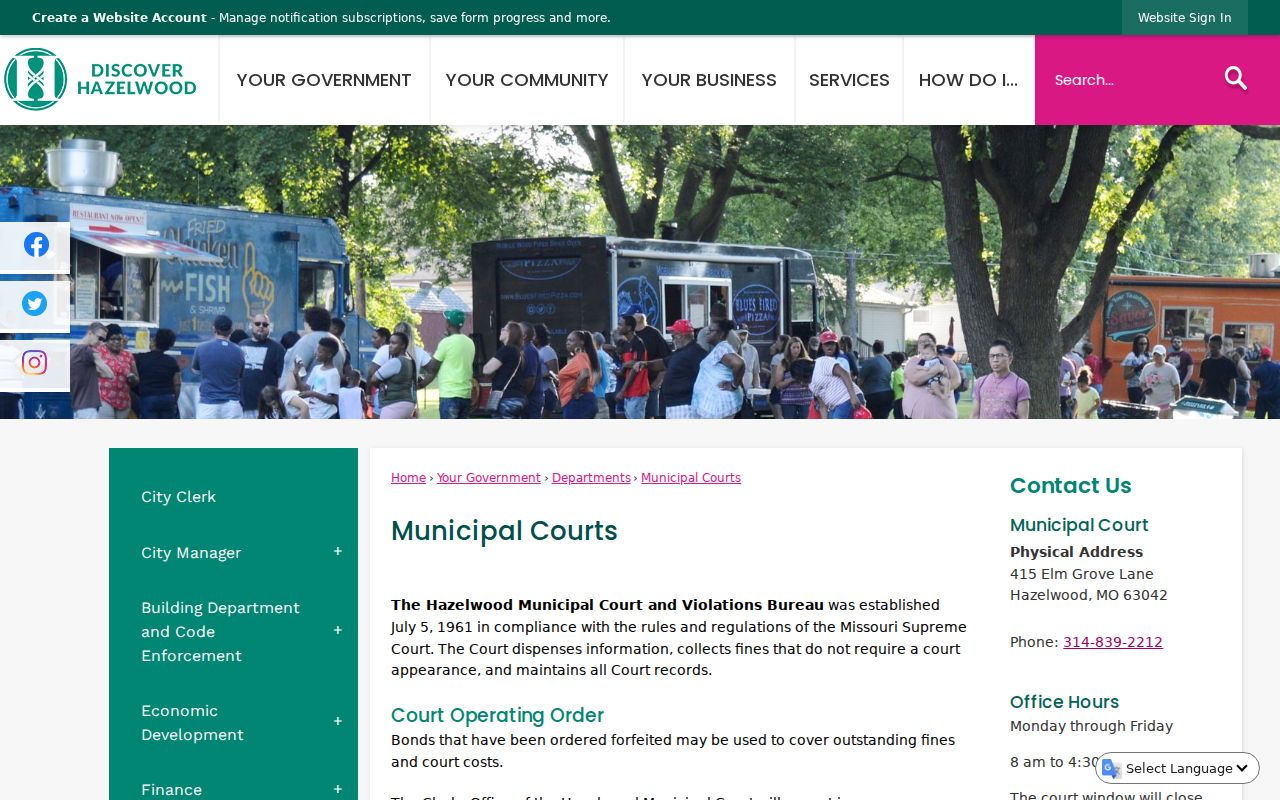
The city’s court page makes the date split visible, which helps prevent sending an older municipal matter through the wrong portal.
Read Hazelwood Case Results Carefully
A usable resident lookup note records only the fields needed to verify the match. For a public case, preserve the case header, court and division, filing date, case type, parties and roles, docket event date, hearing, motion or order title, and final disposition if shown. A court party is a procedural role, not a statement about where that person lives or whether an allegation was proven.
- Discovery: an index hit, name match, or search-result row.
- Confirmation: a dated image, clerk response, certified record, or second independent source.
- Disposition: the recorded outcome, which must not be inferred from a charge alone.
- Restriction: a sign that the court limits remote access or documents.
That distinction is useful when the same person appears in a Hazelwood directory and a public docket. Keep the results separate until the date and identity align. A missing public result is not proof that no case exists, since the search may use a different jurisdiction or the matter may be restricted.
Verify a Hazelwood Resident Lookup
Verification means checking whether two dated sources describe the same person and role. For an address-related question, use the tax inquiry or GIS as an assessment lead, then ask the Recorder for the recorded instrument. For a name question, begin with the official source tied to the event, then add a library, court, or eligible vital-record confirmation only when it fits the purpose.
- Anchor the name to a date and a jurisdiction. Note whether the source is Hazelwood, St. Louis County, or Missouri.
- Search the county property inquiry or GIS when an address or parcel is known. Record the situs, owner field, property number, and year without treating owner as occupant.
- Use Case.net for a court question and compare the party role, court, docket date, and disposition.
- For a family event, use the custodian’s current application and confirm eligibility before requesting a certified copy.
- Keep a result as indexed-only until a dated image, clerk response, certified record, or independent source corroborates it.
- Docket
- A chronological court log of filings, hearings, orders, and other case events.
- Index versus image
- An index points to a record; an image is the scanned record itself and can reveal context the index does not show.
- Certified copy
- A custodian-issued copy certified under that office’s rules, often requested when an official copy is needed.
Note: A parcel owner, deed grantee, permit applicant, and directory entry can all identify different roles at different dates.
Hazelwood Vital Record Boundaries
Vital records are not a public name-search tool. Missouri DHSS requires direct and tangible interest under 19 CSR 10-10. State birth and death registration begins January 1, 1910, while St. Louis County local access covers births from 1920 and deaths from 1980. The County application is for eligible certified copies, not an open index. Death records more than 50 years old have a statutory access exception under RSMo §193.245, but birth, marriage, and divorce records do not share a general public opening period.
The St. Louis County birth and death application is the local route when the record type, coverage, and eligibility fit. It asks for identifying event details, applicant identity, relationship or authorization, copies, supporting identification, signature, and payment. Choose the correct office for the event: the Recorder holds the original marriage record where the license was issued, and the Circuit Clerk holds the original divorce decree.
See the County application instructions for local birth and death copy requirements.
The County route is useful because it makes eligibility and application fields visible before a family submits a request.
The Missouri DHSS forms page separates birth, death, marriage, divorce, correction, adoption, paternity, and delayed-birth forms. Use the current form rather than an old saved blank.
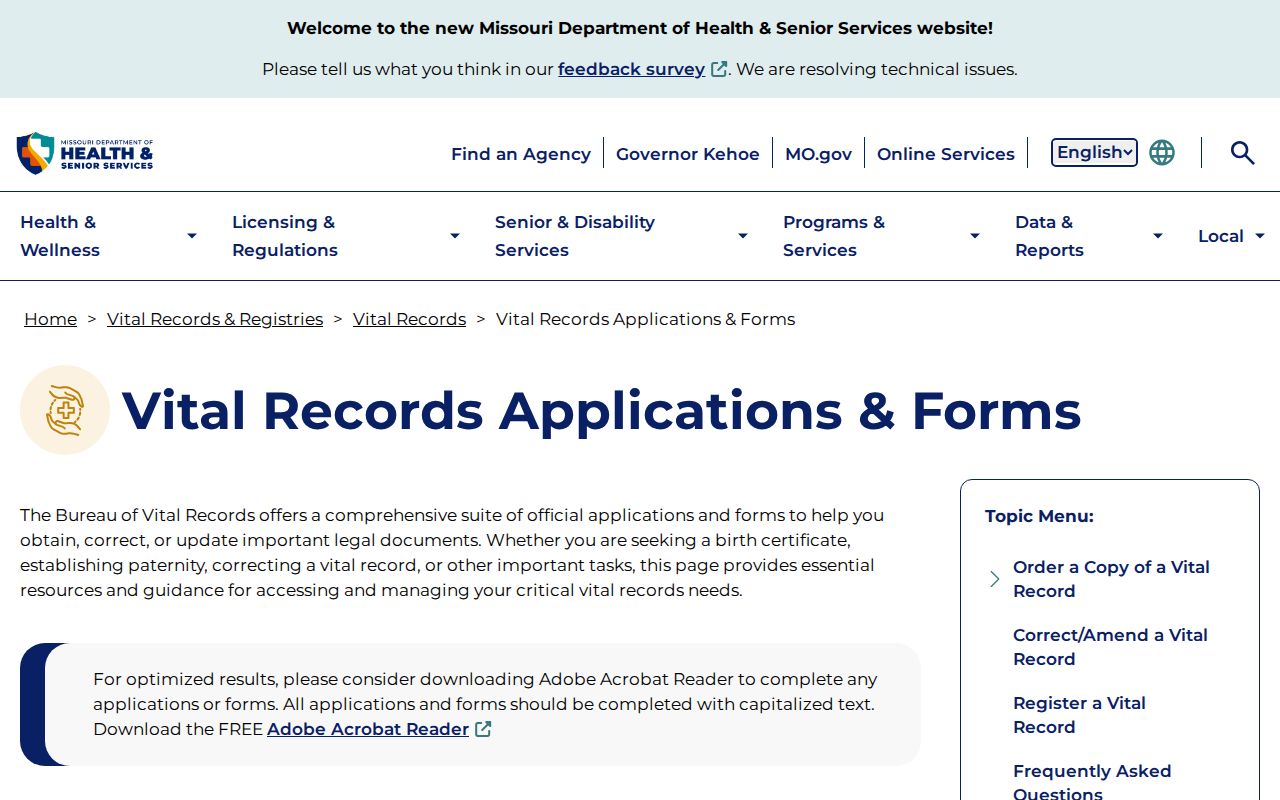
Separate form families help a requester send a marriage, divorce, or correction inquiry to the correct custodian.
Hazelwood Police Record Context
Hazelwood Police Records Unit provides report-copy access by phone or in person for a fee and performs local record checks without charge. A police record can document an incident date, place, report number, or public status, subject to redactions and Missouri Sunshine Law exemptions. It does not establish a current address, a conviction, or every fact surrounding an event.
Use the Records Unit for a defined report or local record-check question. Active investigations, victim and witness information, juvenile material, and protected details may be withheld. If a public court matter is also involved, compare a public docket’s disposition with the police report route instead of assuming an incident report states the final legal outcome.
Open the Hazelwood Police Records Unit page for the official request route and contact details.
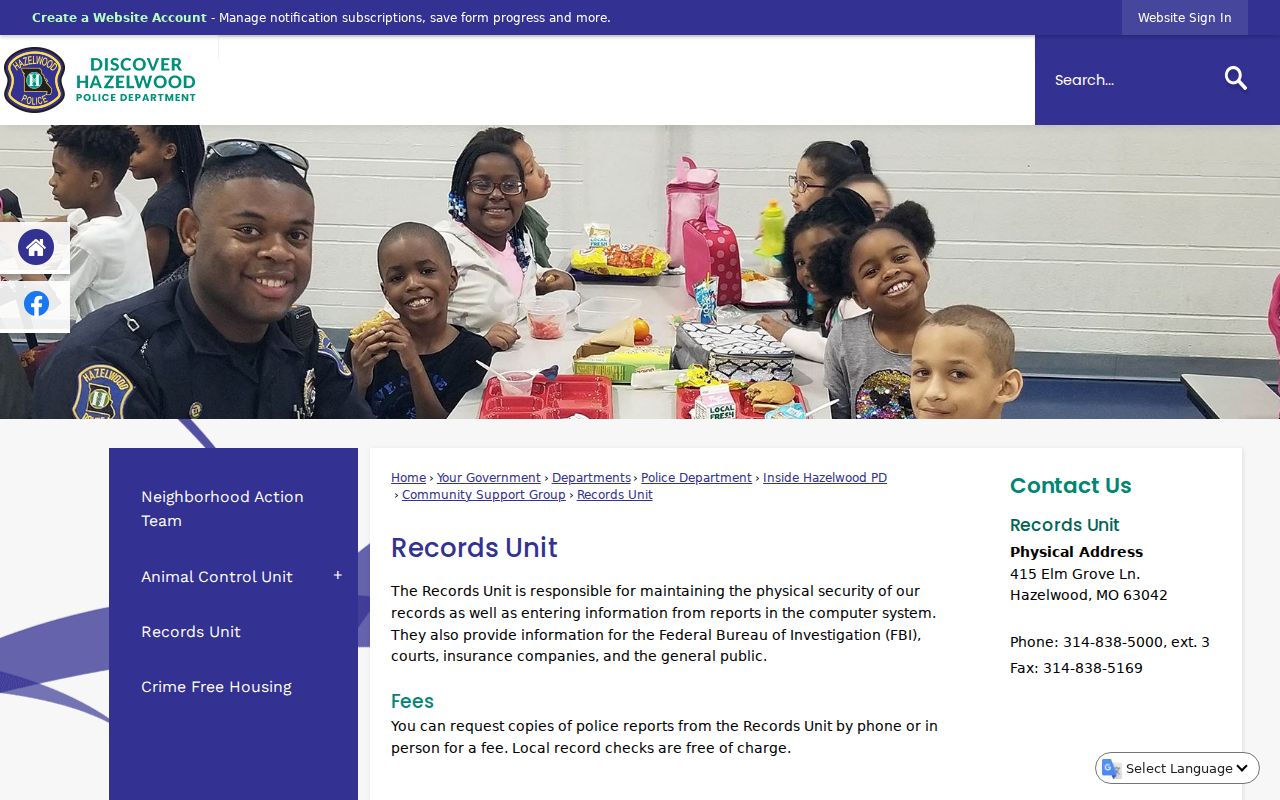
The official records page is the proper starting point for a defined report request, rather than an attempt to assemble a private profile.
Protect Hazelwood Resident Lookup Results
Missouri limits access record by record. Safe at Home provides a substitute address for eligible survivors, and government and court offices must accept it in covered transactions. Protected voter addresses can be closed under RSMo §§115.157 and 115.163. Sealed or expunged court matters, restricted family information, and vital records also remain outside an ordinary public search. A protected result is a reason to stop, not a gap to work around.
For government records that are not online, the Missouri Sunshine Law, Chapter 610 RSMo, directs public bodies to act as soon as possible and no later than the end of the third business day, subject to lawful exemptions. A focused request names the office, record series, date range, and desired inspection or copy format. It asks for an existing record, not a new resident list.
Note: When privacy rules limit a result, retain the custodian, date, and reason for the limit instead of attempting a more intrusive search.